

If you ask any construction worker, linemen, mechanic, truck driver, welder, or farmer about why they hated their department store belt you'll hear one thing over and over:
“I’m tired of belts stretching out, cracking, rolling over, and failing.”
Most “work belts” you see in stores aren’t really work belts. They’re fashion belts painted to look tough. A true work-grade belt needs to do something simple, but incredibly demanding:
Hold your pants up, control weight, and handle hard work — every single day — without failing.
So let’s talk about what actually makes a belt worthy of real work.
Jump to section (tap to expand)
What Does “Work-Grade” Actually Mean?
A belt isn’t jewelry. It isn’t a fashion accessory when you earn a living with your hands.
A work-grade belt should:
- stay stable under load
- resist stretching
- not roll over under pressure
- not crack or peel
- last years, not months
Most belts fail because they’re made cheap. Wrong leather. Minimal thickness. Cheap fillers. Weak hardware. More marketing than engineering.
A real work belt is built from the right material, the right thickness, and the right hardware — period.
1. Leather Quality Matters More Than Anything
If you’ve read anything from Hanks before, you already know this. But it’s worth repeating:
The best work belt starts with full-grain leather.
Not “genuine leather.” Not bonded leather. Not thin “fashion leather.”
Full-grain leather is:
- the strongest part of the hide
- tightly grained and naturally tough
- resistant to cracking and peeling
- capable of handling real stress and weight
When you buy a belt that cracks at the holes or splits at the buckle, that’s almost always because it’s made from cheap leather.
A work belt needs to be a solid piece of full-grain leather, not layered junk.
2. Thickness Is Absolutely Critical
This is one of the biggest differences between a “nice belt” and a true work belt.
A flimsy belt rolls, stretches out, collapses under weight, and makes you constantly tighten it.
A work-grade belt needs mass and structure.
Most true work belts fall in the 10–14 oz leather range. That thickness keeps it stable under load. It prevents rolling. It gives the belt backbone.
If you’re hanging tools, radios, pouches, or other gear off your belt, that stability matters even more.
3. Hardware Matters More Than People Realize
Cheap buckles ruin belts. A strong belt with a weak buckle becomes a weak belt.
A real work belt should have:
- a tough metal buckle
- no flimsy hardware
- a corrosion-resistant finish
- secure attachment, ideally with screws instead of weak stitched tabs
Bonus points if the buckle attaches with Chicago screws—because you can replace the buckle if it ever fails, instead of throwing the whole belt away.
4. Stitching vs Single-Piece Leather
We get asked this a lot:
“Do I need a stitched belt for work?”
- Some stitching is purely cosmetic and adds a nice touch to the belt’s look.
- Some stitching actually holds two layers of leather together, creating a thicker belt than possible with just one layer.
For a rugged, simple, no-frills work belt, go with one without stitching, like our Everyday Work Belt or our Gunner Belt. However, if you want extra thickness above and beyond, go with a rugged dual-layer like our Montana Bison Belt.
All of them carry our 100-Year Warranty and will last you for decades.
5. Width – Why 1.5" Is the Sweet Spot For Men
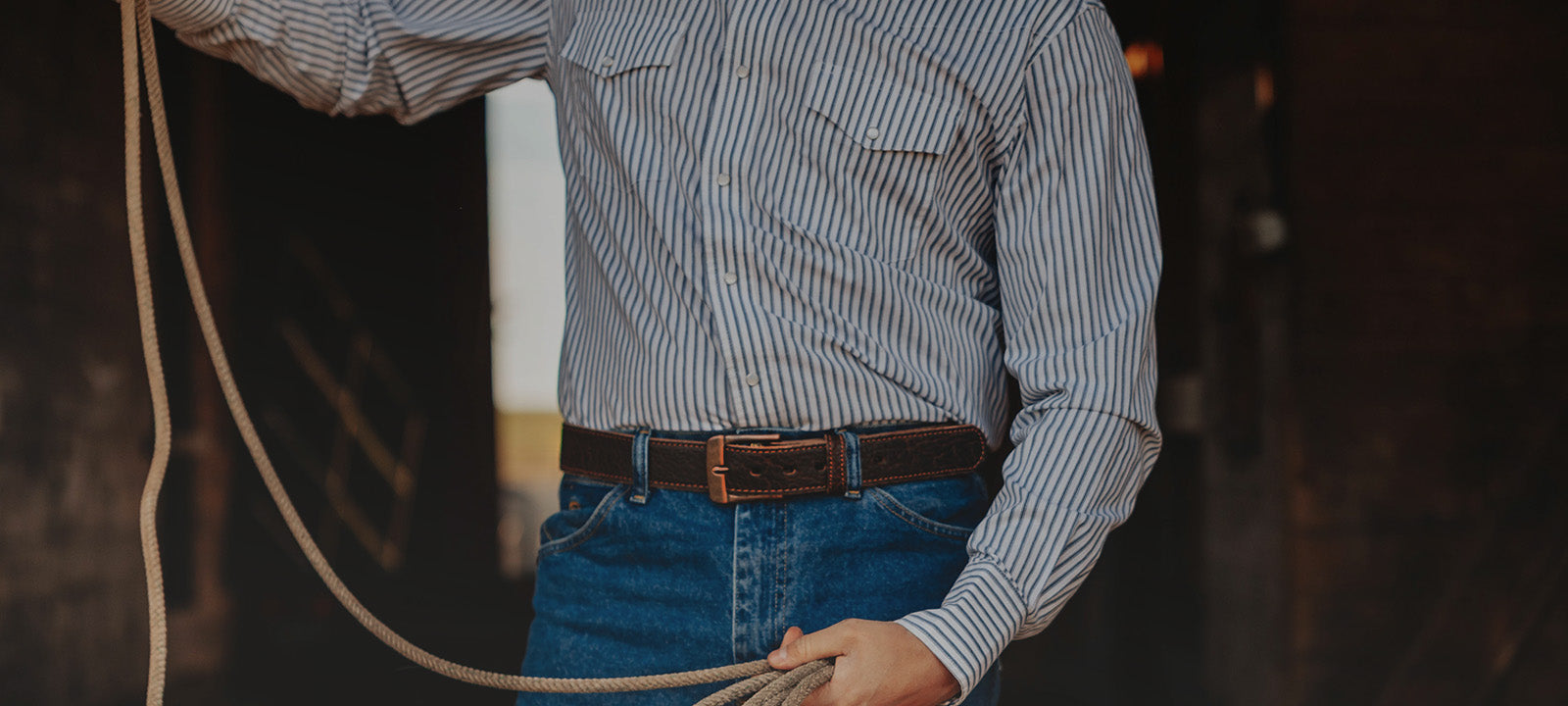
Most true work belts are around 1.5 inches wide. That’s the sweet spot because it provides support, fits standard belt loops, distributes load well, and stays comfortable to wear all day.
At a glance:
- 1.25" – more of a dress belt width
- 1.5" – classic work and everyday width
- 1.75" – heavy-duty for gear and some CCW setups

6. Stretch Resistance and Stability
Here’s something most store belts never mention: cheap belts stretch.
Stretch leads to constant tightening, sagging pants throughout the day, rolling under load, and general discomfort.
Full-grain, heavy leather has natural rigidity. It supports weight and resists stretching.
7. Comfort Still Matters
Work doesn’t have to mean miserable.
A good work belt should not:
- dig into your sides
- have sharp, unfinished edges
- feel stiff and miserable forever
A properly made full-grain belt:
- breaks in like good boots
- molds to your body over time
- gets more comfortable the longer you wear it
Cheap belts don’t “break in.” They just break.
8. Durability Isn’t Just a Marketing Word
Anyone can say “durable.” That doesn’t mean much by itself.
A real work belt should have real-world reviews, years of proven use, a warranty that actually means something, and a company willing to stand behind what they build.
Work Belt vs Store Belt – A Simple Comparison
How to Spot a True Work Belt Quickly
Here are some simple rules to shop smart:
- Look for full-grain leather clearly listed.
- Check for thickness: around 10–14 oz.
- Look for a solid metal buckle, not thin or lightweight.
- Prefer one-piece leather construction or ruggedly stitched dual-layer belts over layered glued belts.
- Check the width — 1.5" is the classic work width.
- Read real reviews from people who work in theirs every day.
Red flags:
- “Genuine leather” with no details.
- Belt feels light, flimsy, or like cardboard.
- Obvious glued layers or fake-looking “grain.”
- Labeled a “premium work belt” at a price that seems too good to be true.
Final Thoughts
A work belt shouldn’t be something you constantly think about. You shouldn’t fight with it. You shouldn’t replace it every year.
Whether you buy one from us or somewhere else, I want you to know what to look for. There’s a big difference between a belt that’s sold as “work tough”… and one that’s actually built that way.
— The Hanks Team
Work Belt FAQ
What makes a belt a “work belt”?
A true work belt is built to handle daily stress, weight, and movement without stretching, cracking, or rolling. It should use full-grain leather, be thick enough (around 10–14 oz), have solid hardware, and be constructed to last years of real-world use.
How thick should a work belt be?
Most quality work belts are around 10–14 oz in leather thickness. This gives the belt enough structure to stay stable under load and resist rolling or collapsing.
Is full-grain leather worth it for a work belt?
Yes. Full-grain leather is the strongest cut of the hide and holds up far better to bending, twisting, and weight than lower-grade leathers or bonded materials. If you want a belt that lasts, full-grain is the way to go.
What width is best for a work belt?
About 1.5" wide is the sweet spot for most work belts. It fits standard jean and work pant belt loops, provides good support, and stays comfortable all day.
Why do my belts always crack or peel?
Most belts that crack or peel are made from “genuine” or bonded leather, or layered materials that are glued together. Once that top layer fails, the whole belt quickly falls apart. A solid piece of full-grain leather doesn’t peel like that.